A good built environment cannot be taken for granted. Our clients are part of the team.
We question.
We ask before we draw: why, and what it will affect, what purpose the project will serve and for whom, and who will look after it — not only now, but in five, ten or twenty years.
What it means for youAn open, focused dialogue at the start prevents unmet expectations at the end.
We design.
For us architecture is not a gesture but the construction of an answer — to the brief, context, budget, operation and time.
We work distributed between Prague, Amsterdam and Košice. Our method: three perspectives, three kinds of experience, three approaches, one way of working.
What it means for youWe offer alternatives and you decide which one to choose. For each one you can see what it offers and what it means for the intended purpose, budget, schedule and operation.
We care.
We see the built environment as a lasting value that needs systematic care.
For us your project does not end with the brief or with completion. We care how the project we developed together lives, how it ages and what can be improved as requirements change.
What it means for youFor us a project is never a closed matter. Throughout our collaboration we tell you how to handle it, what may change along the way and what to consider before it becomes costly.
Transformation
Architecture does not always begin with a blank site.
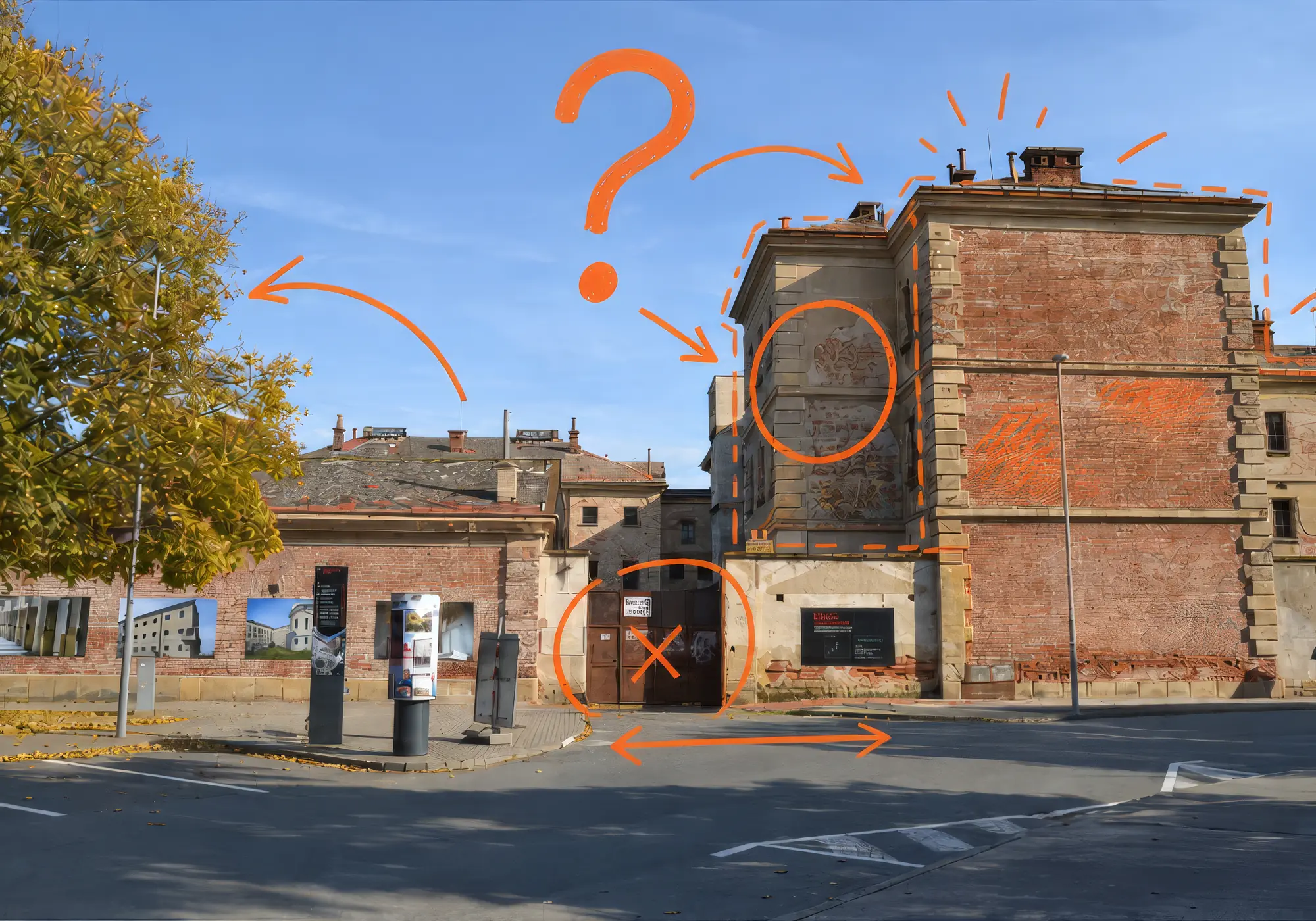
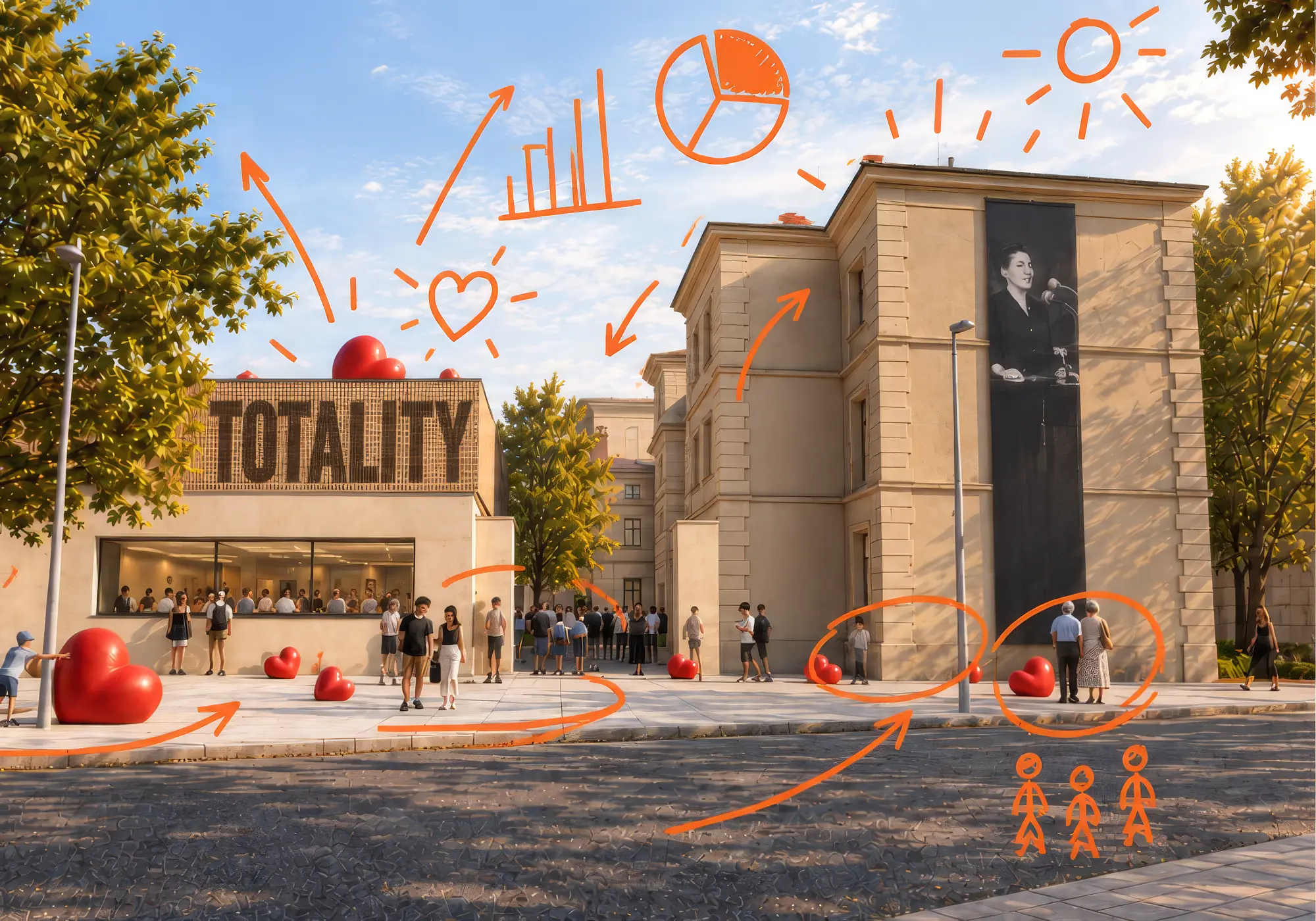
Most of the sites we work on are already built. Existing buildings, sites and landscapes hold value that a new building cannot always replace: material that already carries embodied energy, structures that work, spatial relationships and the memory of a place that people are used to.
So we begin with an inventory of what is already there. Only then do we decide what stays, what changes and what is added. Sometimes a new building may be the better answer, but often it is not. Surveys and options come before the decision to demolish, not after it.
What it means for youFor us, transformation is neither a compromise nor a cheaper version of the new, but a responsible use of your resources.
Resilience
We ask what happens when the surroundings change.
The building stock is renewed more slowly than the conditions it has to serve.
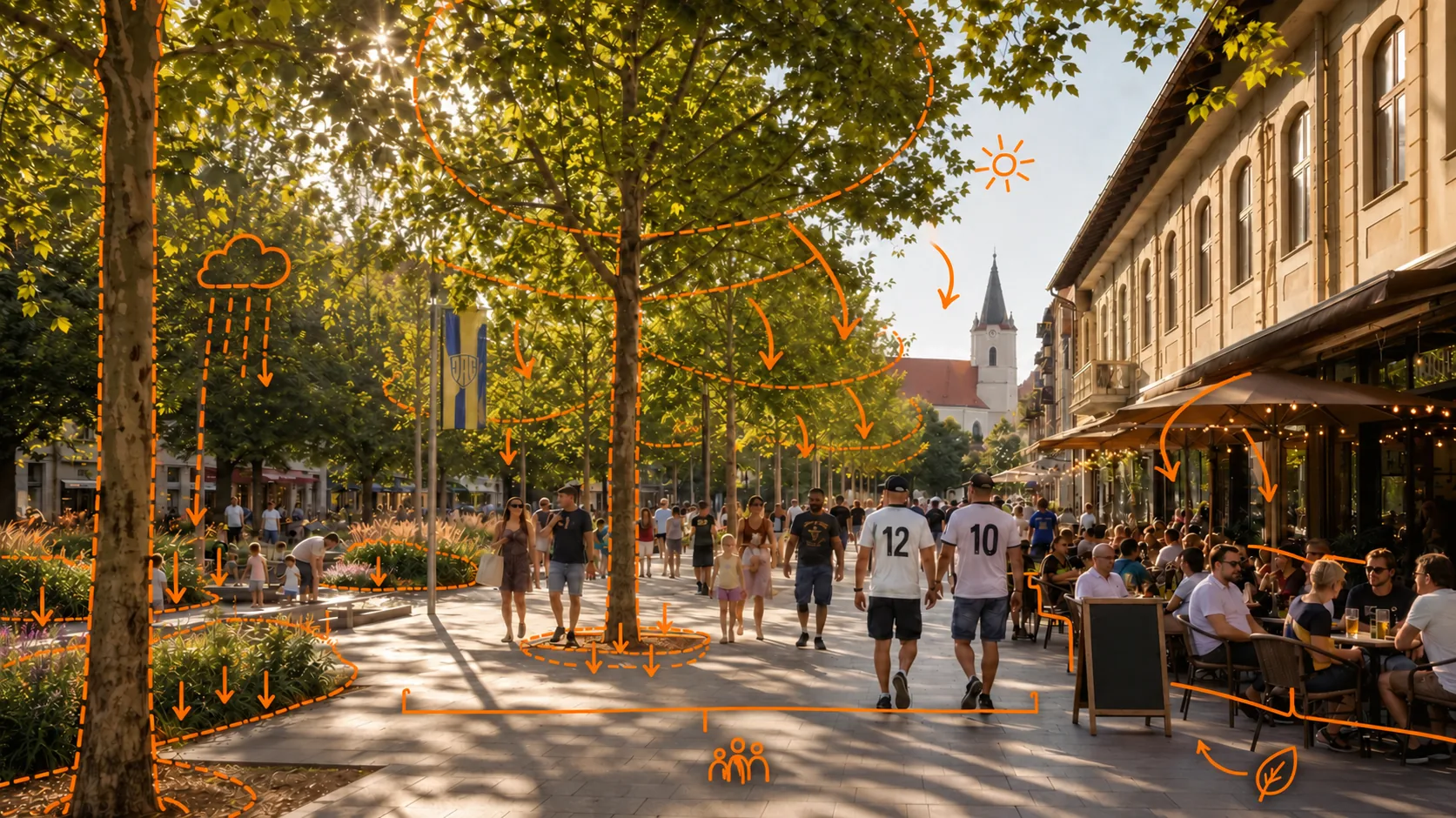
We do not treat resilience as an add-on to the design. For us it is part of the brief. We ask what happens in a heatwave, a cloudburst, a power cut or a change of operation and security, and how much of that the investment has to withstand on its own, without an extra budget.
That is why our design process also works with scenarios that are rare but consequential.
What it means for youResilience is an investment decision, not an attitude. For every measure we say what it costs today, what it saves in operation and which risk it removes. When a measure does not pay off, we say that too and do not propose it.
- Heat
- How the building behaves in a heatwave without air conditioning — shading, mass, night ventilation, trees.
- Water
- Where a cloudburst goes and where water is held for the dry months.
- Outage
- What still works when power, heat or connectivity fails — and for how long.
- Dependencies
- What the building hangs on, which of it has only one option, and what can be doubled up economically.
- Change of use
- What happens to the building when the programme changes — and whether it can take it without demolition.
What we ask
For clients
You decide on the project. We make sure you have the right information in good time.
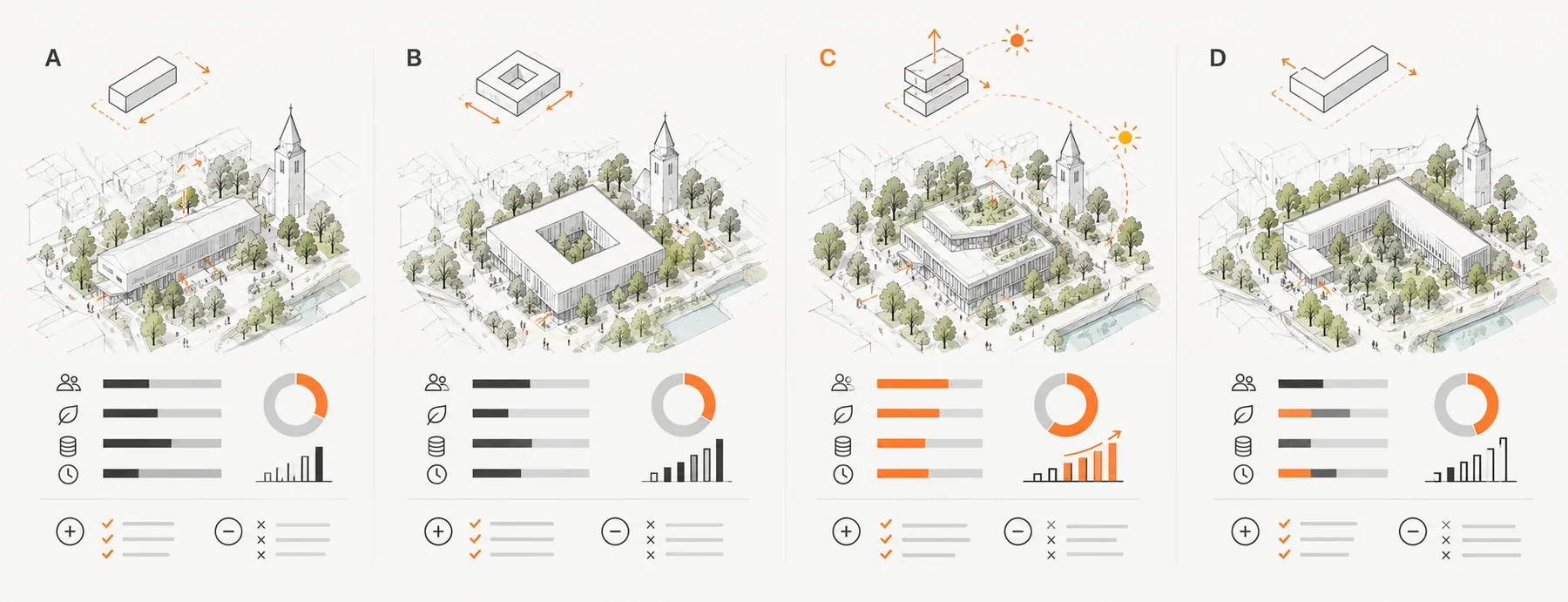
Our design process is set up so that at every stage it is clear what is being decided, what the options are and what follows from them.
-
01
Your priorities
Quality, cost, time and risk affect one another. You set the order; we show what value each order has.
-
02
A clear brief
At the start we define with you what the project must achieve and how we will know it has. We return to it with every decision that follows.
-
03
Visible alternatives
Key decisions are not presented as a finished fact. We show the options side by side, measured the same way, so that you can compare.
-
04
Consequences up front
For each option we say what it means for budget, schedule, operation and permits — before the decision, not once it shows.
-
05
Plain language
We explain drawings, budgets and legal context so that you can take full part in the decisions without having to become an architect.
What it means for youYou know in advance when and on what decisions will be made. Between these points we work independently; at them we stop and you decide.
AI
We use AI every day. We make the decisions.
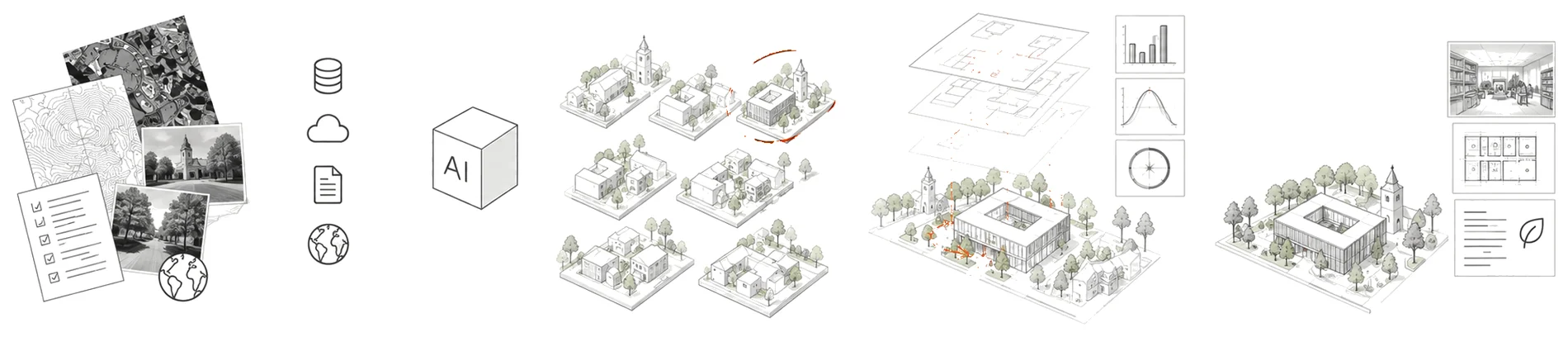
AI is an ordinary part of our work — alongside the sketch, the model, CAD and the database. We use it because it lets us work with more information, test possibilities faster and get further during design. We do not want it to think instead of us. We want to think further because of it.
01
More eyes. More hands. A longer memory.
AI is not another architect. It extends what we can do: in moments it reads large amounts of information, looks for connections, works with text and image and prepares several paths to test. It adds no brain — direction, judgement and decisions stay with people.
02
A new tool. A new way of working.
There is little point in using a new technology only to repeat an old process faster. AI lets us split a problem differently, ask more questions, test something quickly, drop a dead end and continue elsewhere. So we do not only look for what AI can do for us, but above all for what we can do differently because of it.
03
More possibilities. Not more answers.
Speed on its own does not interest us; what we can explore because of it does. Instead of one laboriously produced option we test several materials, atmospheres or routes to a solution — not to have the best one chosen for us, but to understand the problem better. AI widens the space of possibilities; the architect decides which of them makes sense.
04
Every day. Where it makes sense.
We use it in research, in work with data and documents, in comparing options, image studies, programming, automating repetitive work and preparing communication. Sometimes it saves an hour; sometimes it lets us test an idea in minutes that we would otherwise never have tried. It is therefore not one phase of our process but a tool that can appear wherever it helps us see the problem more clearly.
05
An output is not the truth.
AI can produce a convincing image, text or answer. That does not make them right. We treat its outputs not as finished work but as material for review: we verify facts, assess options, confront images with the design and discard what makes no sense. The stronger the tool, the more important it is to know when not to trust it.
06
The result is ours.
AI can go through the background for an email and help draft it; the person who sends it to the client is the one who knows why it is being sent and what it says. Architecture works the same way. We do not divide the result into human and artificial work — we use the sketch, the model, software, databases and AI. What leaves our studio is always our responsibility.
What it means for youAI does not think for us, but it gives us room to understand your intentions better, check the facts and compare options objectively. We are always responsible for what you receive from our studio.